What if you didn’t even have to open the Uber app to get a ride?
At first glance, it sounds like a minor convenience, one more step removed from a process that’s already seamless. But I had a moment recently that made me pause. Not because it was dramatic, but because it was subtle. And sometimes, those are the moments that reveal something deeper.
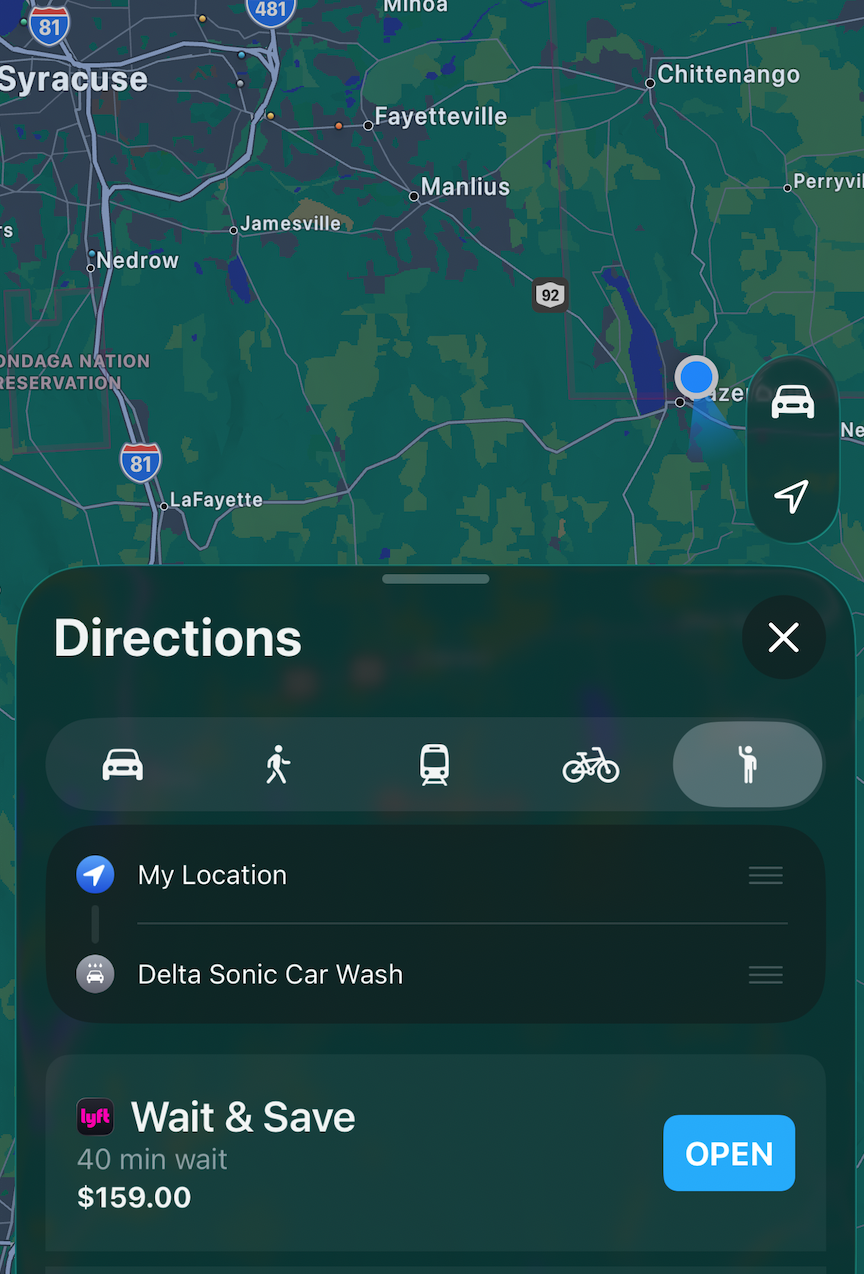
I was sitting in my kitchen, helping my wife plan a trip to the airport. As an Uber driver, I’ve made that trip countless times. I know the timing, the routes, the variables. To reassure her, I opened Apple Maps to show that the drive would take about thirty-five minutes. That part was routine. What wasn’t routine was what I noticed next.
There was a small icon, easy to miss, indicating ride options. When I tapped it, Uber and Lyft prices appeared immediately. I hadn’t opened either app. I hadn’t decided which platform to use. And yet, I was already comparing rides.
That shift, however small it may seem, felt meaningful.
For years, the structure of rideshare has been clear. If you wanted a ride, you opened an app. Uber or Lyft wasn’t just a tool; it was the marketplace. It was the place where supply and demand met, where drivers and passengers connected, where pricing was discovered. The app wasn’t just part of the experience, it was the gateway to it.
But in that moment, the gateway had moved.
Instead of going to Uber, Uber came to me, alongside Lyft, and potentially alongside anything else that could plug into that same interface. The marketplace was no longer a destination. It had become a layer.
What made it more striking was the inconsistency. The same ride, at the same time, showed significantly different prices depending on where I looked. That wasn’t entirely new, any driver or passenger knows that pricing can fluctuate, but seeing it side by side, outside the apps themselves, made it harder to ignore. It introduced hesitation where there had been a habit.
Uber is an extraordinary piece of software. It has solved a complex coordination problem at scale, matching drivers and passengers with remarkable efficiency. But at its core, Uber doesn’t move people. Drivers do. Passengers pay. Uber facilitates the exchange. It is, fundamentally, a middle layer, a marketplace.
And marketplaces derive their power from being the place you go.
So what happens when you don’t have to go there anymore?
If ride options can be surfaced through a broader interface, like a mapping application or, eventually, a voice assistant, the locus of control begins to shift. The decision-making process moves up a layer, away from the individual platforms and into the system that aggregates them.
It doesn’t take much imagination to extend this further. Instead of opening an app and comparing options, you simply state your intent: “I need a ride to the airport.” Your phone, informed by your past behavior, your preferences, your budget, and real-time conditions, selects the best option on your behalf. It may still choose Uber. It may not. But the act of choosing is no longer yours in the same way.
This is not a distant, speculative future. The early pieces of it are already visible.
And that raises a more personal question.
As a driver, I currently use this system by logging in to one or two platforms. I make myself available within those marketplaces. I receive rides based on their algorithms, their demand, and their pricing structures. But if the system evolves, if the marketplace becomes just one of many inputs into a larger decision-making layer, where does that leave me?
Do I need to be present across multiple platforms simultaneously? Do I align with a specific network, whether it’s Uber, Lyft, or something entirely new like autonomous fleets? Do I attempt to build something independent, or do I adapt to whatever structure emerges above these existing apps?
I don’t have a clear answer.
What I do know is that the moment didn’t feel abstract. It didn’t feel like a theoretical discussion about technology or market dynamics. It felt immediate. I opened my phone to do something simple, only to encounter a version of the system that operated differently than I expected.
It was a small change.
But it suggested a larger shift.
And once you notice something like that, it’s difficult to unsee it.