Uber Driver Pay Is Broken. Or Is It?
Upfront Tip
Weekly. Free. Straight from the driver's seat.
A few weeks ago in Miami, I showed an Uber executive a trip that perfectly illustrated what's wrong with Uber driver pay. The offer was $9.07 to go about 13 miles in 31 minutes. So, at my cost of $ 0.30 per mile, I would've spent $4 driving, which left me with about $5 in profit, or $9.72 an hour. And that's less than the New York State minimum wage of $16 an hour.
Honestly, I made my point. She looked at the simple question:
“Did you take it?”
No.
“Then what’s the problem?”
Honestly, that question has stuck with me ever since. I'm not saying it was a great ride. It was a terrible offer. I wouldn't take it today, but her question forced me to think about something bigger than whether one individual Uber trip offer was good or bad.
What exactly do I want Uber to do?
Well, I wanna make more money. I want other drivers to make more money. That's the easy part.
The hard question is, how do we get there? How do drivers earn more money?
A lot of the drivers I respect believe the answer is a rate card. Easy. Just establish a minimum amount per mile and per minute. Put a floor underneath driver pay. Let surge, promotions, bonuses, and tips sit on top of that. And I understand the appeal. A rate card is simple. It is predictable. Most importantly, it is understandable.
So I decided to test it.
I took the Uber rides I completed on a recent Friday and repriced them using the Washington State minimum compensation formula I had been studying. My actual fares were around $173. Under the Washington-style calculation, they would have been around $234.
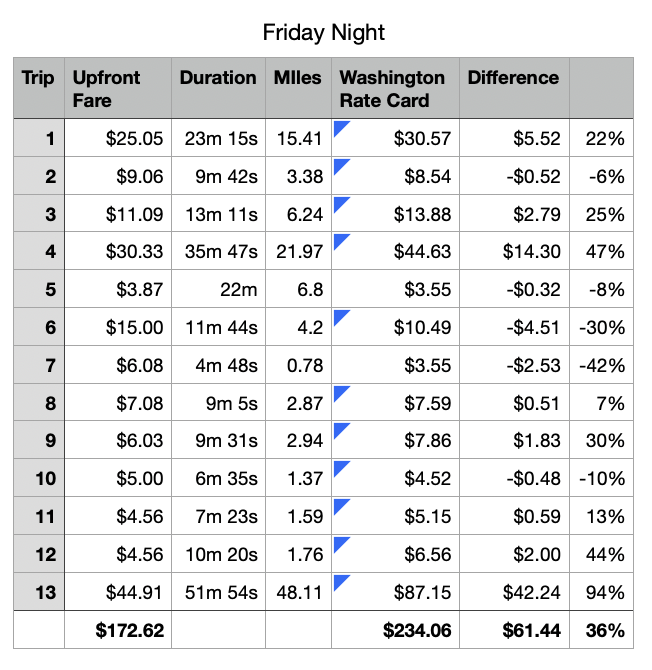
That is about $61 more, or roughly 36 percent.
Point for the rate card.
If the only question were, “Would I have made more money on these exact trips?” the answer is yes. But almost all of that improvement came from two long rides. Trips number four and thirteen accounted for roughly 92 percent of the difference.
The short rides told a different story.
One trip paid me $15 under Uber’s upfront pricing. Using the Washington formula, it would have paid around $10.49. Why did Uber pay me $15? I have no idea. There was a small surge, but it didn't explain the full difference.
That is part of what makes Uber’s current pricing system both frustrating and interesting. Sometimes I get an offer that looks ridiculously low. Sometimes I get one that seems unusually good. I do not really understand why.
That is why I have described Uber as a game. Sometimes it even feels like a casino. The cards come one at a time. A six. An eight. A ten. I should have taken the ten. But I know queens, kings, and aces are somewhere in the deck, so I keep waiting. My acceptance rate falls because I am waiting for the rides I want.
A fixed rate card changes that game.
If a Washington-style formula came to Syracuse, I would probably change the way I drive. I like short trips today. Short pickup. Short passenger ride. Good fare. A tip could be a tip. Finish quickly and get another passenger.
Under a stronger time-and-mile formula, I would become much more interested in long paid trips, high utilization, low deadhead, low operating costs, and tips. I would be trying to keep a passenger in the car and the wheels turning.
That starts to look a lot more like taxi economics.
There is nothing necessarily wrong with that. It is simply a different system.
Deadhead matters too. My longest ride on that Friday paid $44.91 in base fare. Under the Washington calculation, it would have paid around $87.15. That sounds fantastic.
But the entire business cycle around that ride was about 82 miles. At my 30-cent-per-mile cost, that is roughly $24.60 in vehicle expense. The passenger portion of a ride is not always the same thing as the economic reality for the driver.
This is also why I have become uncomfortable calling an offer universally “bad.”
That $9.07 trip I showed the Uber executive was a Trip Radar request. It was not an Exclusive offer. I evaluated it based on where I was, how far I had to drive to the passenger, the cost of operating my Tesla, and what that destination meant to me.
Another driver might have been sitting much closer. They might have had a cheaper car. They might have wanted to go exactly where that passenger was going.
The same $9.07 can represent two completely different economic transactions to two different drivers.
That raises another question: who defines fair?
I can tell you whether a trip is fair to me. I am much less comfortable deciding that another competent adult is ignorant, exploited, or incapable of understanding their own interests simply because they accepted a ride I would have declined.
Agency has to include the freedom to make a decision somebody else thinks is bad.
That does not mean Uber’s system deserves a free pass.
Professor Len Sherman has used some of my data, along with GigU data, to argue that upfront pricing gives Uber a massive information advantage and has helped push driver pay down. My own data supports parts of that argument.
I do not dismiss it.
Uber sees millions of offers, acceptances, declines, rider prices, driver behavior, supply, and demand. I see one offer on my phone.
That imbalance is real.
But information asymmetry is not unique to Uber. I have hired subcontractors before. I knew what my customer was paying me. I knew my margin. I knew what other vendors might charge. The subcontractor did not necessarily know any of that.
I would make an offer. They could accept it or reject it. Unequal information did not automatically make the transaction immoral. That is where I struggle with some of the rhetoric around Uber. I am comfortable saying Uber sends some terrible offers. I am comfortable saying Uber has a tremendous information advantage. Drivers may be getting paid less than they used to.
I am not comfortable jumping from those observations to “Uber is malicious,” “Uber is exploiting millions of helpless people,” or “government therefore needs to determine the acceptable price of every ride.”
Maybe I am wrong. But something deeply important is respecting the agency of the person on the other side of the screen.
Uber does not owe me an explanation for every fare. But it would benefit from giving drivers a better one.
Opacity creates distrust. When I do not know why one trip pays $9 and another seemingly similar trip pays $15, I fill in the blank myself. So do other drivers. Usually we fill it with the worst possible explanation.
Maybe Uber is testing how little somebody will accept. Maybe they are taking advantage of inexperienced drivers. Maybe the algorithm is deliberately squeezing us. Maybe. Or there are marketplace dynamics I cannot see.
I do not need Uber’s source code. I would like to understand better the marketplace I am participating in.
And I would like quality to matter more. I have a 5.00 rating, a 99 CMT safety score, around 16,000 completed trips, and more than six years of experience. Safety, professionalism, reliability, and experience have value. I want Uber to decide that those things are worth something if they create value for riders and for the marketplace.
That brings me back to acceptance rate. Maybe we have been thinking about it backward. If Uber wants drivers to accept more of what they are sent, the answer may be not convincing drivers to take worse offers. The answer may be getting better at finding the right trip, at the right price, for the right driver.
My acceptance rate should rise because the matching gets better, not because my standards get lower.
That is my ideal Uber marketplace.
Keep dynamic pricing. Let Uber decide what it wants to offer. Let me decide whether I want the trip. Sometimes Uber will offer too little. Sometimes I will get a fare that seems unusually generous. Sometimes we will not have a deal.
That is okay.
Give drivers more information. Improve the matching. Reward quality where it creates value. Preserve the flexibility that made rideshare different in the first place.
Would that make drivers more money? I do not know. A government rate card might make me more money. My own Friday numbers suggest that it could. But I am not convinced it solves the deeper question.
I know what I want. I want drivers to make more money. I want to make more money.
I am just still trying to answer the harder question:
How do we actually get there?