Want to know why your Ubers are so expensive?
I estimate that a full-time Uber driver operating at my recent pace in upstate New York would generate more than $20,000 a year in Uber’s “estimated commercial auto insurance and operational expenses” category.
How much of that is actually commercial auto insurance?
Uber does not tell us.
Here’s an example trip.
An Uber passenger paid $101, and I only got $37, no tip. My tweet got 33K views.
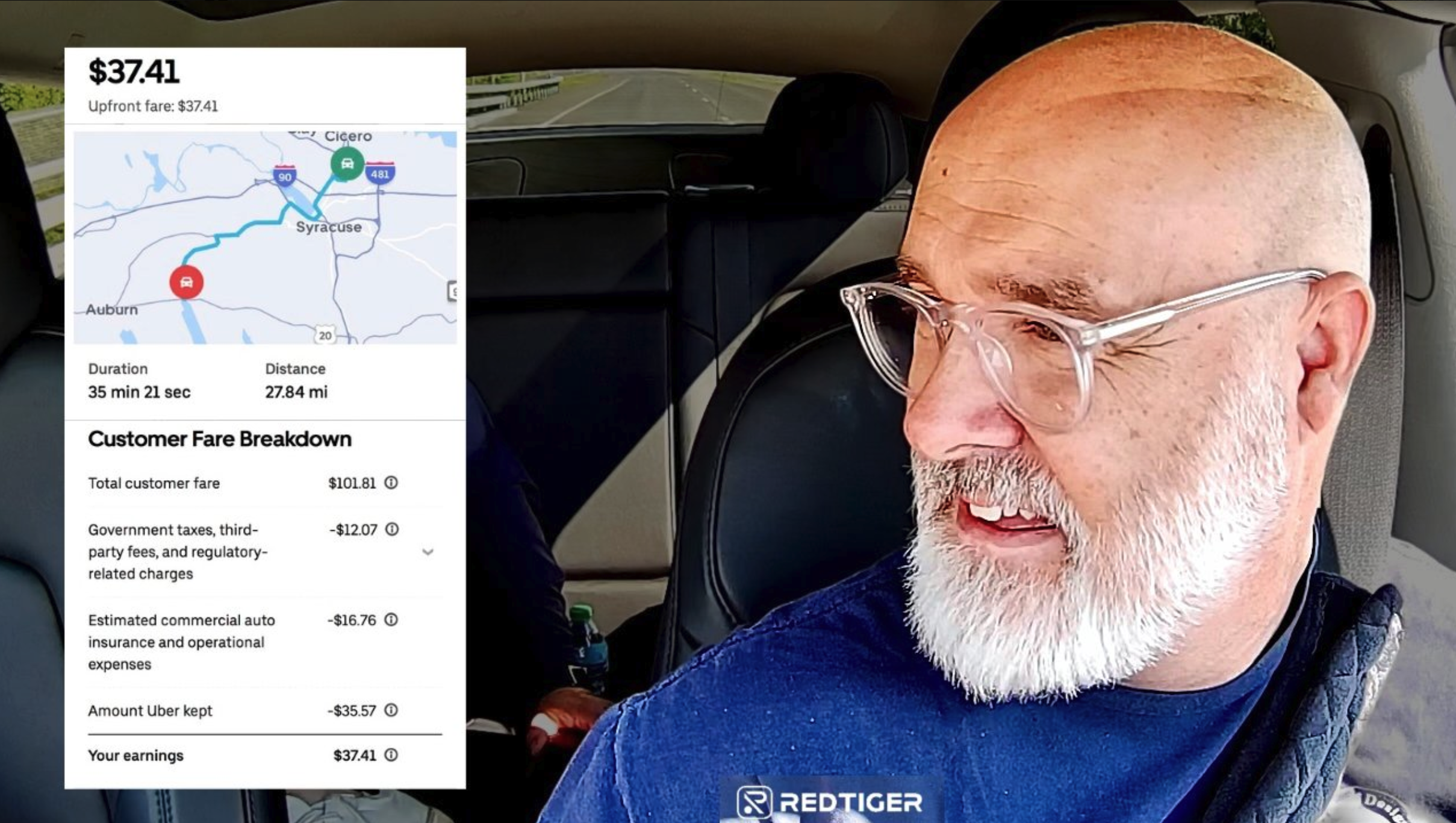
@levispires July 13th 2026: He said I did a great job. Then he tipped $0. Uber charged him $101.81 and paid me $37.41. He didn’t owe me a tip. What hurts is not knowing why he didn’t leave one. Did I do something wrong? Does he not believe in tipping? Did he forget? I’ll never know. And that's a problem.
Upfront Tip
Weekly. Free. Straight from the driver's seat.
My math.
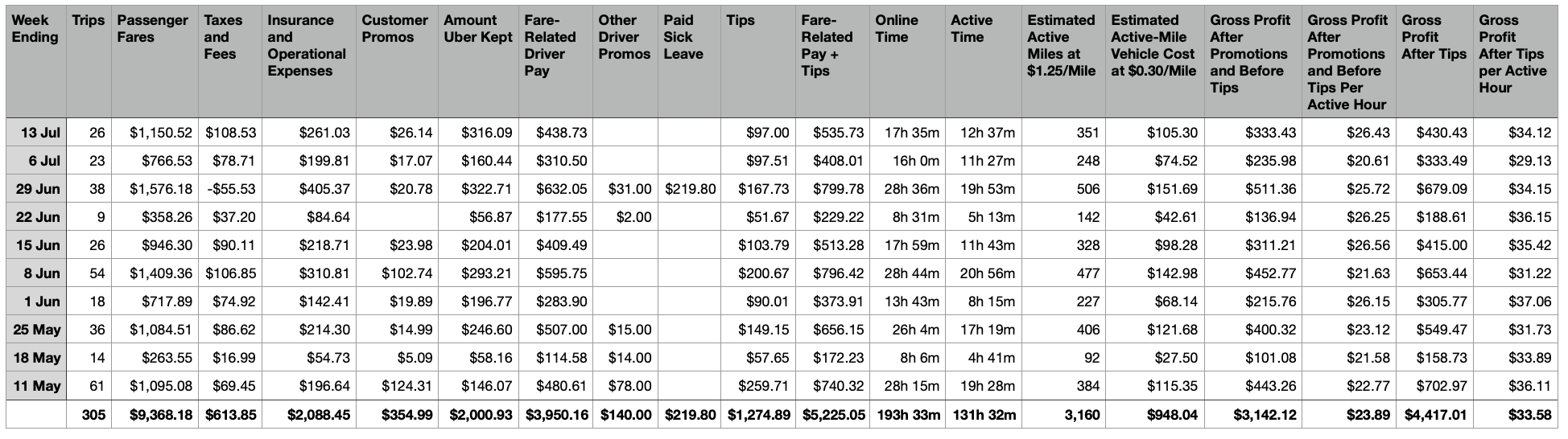
Over the last 10 weeks, my Uber passengers paid $9,368 for 305 trips.
Uber paid me $3,950 for those trips. That includes my base fares and Uber Pro Perk payments. But it excludes tips, paid sick leave, and $140 in other driver promotions.
I estimate that I drove approximately 3,160 active miles over those 10 weeks. These are the miles for picking up and dropping off passengers. I assumed a $1.25 fare per active mile, based on my 2025 mileage and earnings data and recent trips. Uber does not publish my active mileage, so this is an estimate rather than an exact measurement.
Those active miles cost me approximately $948. My cost is 30 cents per mile for electricity, maintenance, and depreciation.
After adding the $140 in other driver promotions and subtracting those estimated vehicle costs, I had $3,142 before tips, taxes, deadhead mileage, and other fixed business expenses. Spread across the 193.5 hours I was online, that amounts to approximately $16.23 per hour online. Basically minimum wage. Of course, I am an independent contractor rather than an employee, and my calculation still excludes some business costs.
Uber’s customer fare statements show the company kept $2,001 from those rides. That is not Uber’s final profit. The company still incurs costs for employees, technology, marketing, support, legal, and other corporate expenses. But it is the amount Uber presents as the portion of my passengers’ fares that it kept for itself. Uber listed an even larger amount of $2,088 under: Estimated commercial auto insurance and operational expenses.
Uber does not show drivers how that category is divided between insurance and operational expenses. The company says the estimate reflects trip risk based on factors such as distance, duration, location, time, and weather. Uber also says the amount is not specifically tied to the actual insurance cost of that particular trip. Still, Uber describes the category primarily in terms of commercial auto insurance and insurance-related costs. It does not separately itemize the company’s other operating expenses on each driver’s fare statement. Yet it routinely sends drivers, passengers, and anyone else who will listen that most of this is commercial auto insurance.
That $2,088 represented 22.3% of everything my passengers paid. It was larger than the 21.4% Uber says it kept for itself. It equaled approximately:
66 cents for every active mile
$15.88 for every active hour
$10.79 for every online hour
My utilization rate during those ten weeks was 68%. That means that during a 40-hour online workweek, I would be actively driving to or transporting passengers for about 27.2 hours. During the remaining 12.8 hours, I might be waiting for another trip, repositioning, cleaning it, or just driving without a booked trip.
I averaged approximately 24 active miles per active hour. At 27.2 active hours each week, that would equal about 653 active miles per week. Over 50 working weeks, that becomes approximately 32,654 active miles per year.
At my recent rate of 66 cents per active mile, Uber would allocate approximately $21,580 per year to estimated commercial auto insurance and operational expenses for one full-time driver.
Uber does not disclose how much of that amount is insurance. But if insurance represents most of the category, the annual insurance allocation could approach $20,000. That would be approximately $1,667 per month.
Again, that does not mean Uber buys an individual $20,000 policy in my name. Uber pools the risk across drivers and trips and uses a combination of outside insurance and self-insurance arrangements. But the money is still being generated by the passengers I transport and assigned to that category.
So why does Uber insurance cost so much?
Reporters started calling me.
This question did not begin with my most recent ten weeks of driving. It began last year with one seven-mile trip.
Uber offered me $9.20 to drive a passenger from a hotel to the Syracuse airport. After the ride, he tipped me $9.50. That was more than the fare itself, so I opened the passenger-fare breakdown to see what had happened.
The passenger had paid $47.21. Uber assigned $23.46 to estimated commercial auto insurance and operational expenses. I received roughly $9. The passenger had paid more toward Uber’s insurance category than he had paid the person who supplied the car and completed the trip.
I made a video and wrote about that trip. And of course, one strange trip doesn’t prove much. But it was strange enough that I started looking.
I had already been collecting a much larger set of receipts from one of the most consistent routes I drive: Ithaca to the Syracuse Airport. I was trying to find ways to make more money.
Over 24 months, I found 159 trips in that direction. I narrowed the data to 129 trips for which I had complete information on passenger payments and Uber fees. Each trip was approximately 62 miles, usually took about an hour and fifteen minutes, and involved the same driver, the same Tesla, and the same route. Passenger prices varied dramatically. Some passengers paid less than $80, while others paid more than $250 after tips.
But one of the most difficult variables to explain was Uber’s insurance-and-operations estimate. It ranged from $13.75 to $50. Same driver. Same car. Same route. Nearly the exact same 62-mile distance.
I wrote and made a video about that too. And I gave access to anyone who wanted all the data.
That’s when Columbia Business School professor Len Sherman picked up the research. He incorporated 100 of my Reserve trips on the Ithaca-to-Syracuse route into his broader analysis of Uber’s pricing and take rate.
Then the story moved beyond my website.
Fast Company covered Sherman’s research and highlighted the $13-to-$50 insurance range on my Ithaca-to-Syracuse trips. Business Insider published a story specifically about the variation in Uber’s insurance estimates. Over the past few weeks, I spent a day with a journalist from Business Insider and another with a journalist from A More Perfect Union, recording videos.
I am not an actuary or an insurance-industry expert. I am an Uber driver who spent years collecting receipts and noticed something that was hard to explain.
Now other people are asking the same question.
What does Uber’s commercial insurance provide?
Commercial rideshare insurance is real, necessary, and expensive.
A normal personal auto policy may exclude coverage while a driver is using a vehicle for rideshare work. That creates an obvious problem: a personal car is being used commercially to transport strangers, often for thousands of miles each month.
New York requires additional coverage.
When a driver is logged into the app and waiting for a trip request, the policy must provide at least $75,000 for injury or death to one person, $150,000 for injury or death to two or more people, and $25,000 for property damage. It must also include uninsured-motorist coverage and personal injury protection.
Once a New York driver begins a prearranged trip, the required liability coverage rises to $1.25 million. The policy must also include $1.25 million in supplemental uninsured or underinsured motorist coverage and no-fault personal injury protection.
Those are real protections. A serious crash can produce enormous medical bills, property damage, legal expenses, and long-term claims. An individual Uber driver could not reasonably absorb that risk.
But the million-dollar policy does not mean a driver receives a million dollars if something goes wrong.
Most of the coverage protects passengers, third parties, property owners, and Uber against liability. The driver’s own vehicle is treated differently.
Uber says it maintains contingent physical-damage coverage after a driver accepts a trip, but only if the driver already carries comprehensive and collision coverage on their personal policy. The coverage is limited to the vehicle’s actual cash value and ordinarily carries a $2,500 deductible.
Uber also states that it does not provide collision or comprehensive coverage while a driver is online waiting for a request but has not yet accepted one.
That leaves drivers carrying meaningful risk even as a large portion of passenger fares is allocated to insurance.
A driver may still face:
A $2,500 deductible.
Lost income while the vehicle is being repaired.
Depreciation after an accident.
A loan balance greater than the vehicle’s insurance value.
Rental-car costs or limited access to an eligible replacement vehicle.
Damage occurring while online but waiting for a request.
Medical or disability losses not fully covered by the applicable policy.
The policy has value. But “Uber provides a million dollars in insurance” does not fully describe what the driver receives.
What does the receipt number actually represent?
This is where the story becomes more complicated. The line on my statement is not simply labeled “insurance premium.” It is labeled “Estimated commercial auto insurance and operational expenses.”
Uber explains that it estimates the risk-related cost of an individual trip using factors such as distance, duration, location, time of day, and weather. But Uber also says something extremely important:
“This amount is not specifically tied to per-trip insurance costs.”
Uber says the operational-expense portion accounts for insurance-related personal-injury litigation and differences between the estimate shown on a trip and Uber’s eventual actual insurance costs.
In other words, the amount attached to my receipt is an allocation.
It is not necessarily what an insurance company charged Uber to cover that specific ride. It can help fund claims from other rides, legal costs from other cases, differences between prior estimates and actual losses, and broader insurance-related expenses.
That does not automatically make the allocation improper. Insurance always involves pooling risk. Most people pay premiums and never make a major claim. Their money pays for the smaller number of people who experience catastrophic losses.
But Uber’s description makes the variation in my receipts more interesting, not less.
If one 62-mile airport trip receives a $13.75 estimate and another receives a $50 estimate, what caused the difference?
Distance alone cannot explain much, as the routes were nearly identical. The vehicle and driver were identical. The service type was controlled in Sherman’s analysis. Weather, time, location, and marketplace conditions may account for some of the movement, but a range from $13.75 to $50 represents more than a 260% difference.
When Business Insider asked Uber about the findings, the company again cited the trip’s origin city, distance, duration, time of day, and weather. Sherman responded that nearly identical trips involving the same car, driver, route, and distance should not produce such large unexplained variation.
Uber’s own website says variation at the national level is “typically minor.”
Mine was not.
Uber’s insurance and take rate explained.
The insurance category also matters because of how Uber defines its take.
Uber says its average U.S. revenue per trip, what it calls its take rate, is around 20% after insurance and other third-party expenses are removed. Uber argues that including mandatory insurance in the company’s take produces an artificially inflated number because insurance is a genuine cost of providing rides.
That position is not unreasonable.
Uber’s $2,001 from my recent rides is not the company’s final net profit. Uber still incurs costs for employees, technology, marketing, support operations, payment processing, facilities, legal expenses, and many other expenses.
In the same way, the $3,142 remaining after I assign 30 cents per active mile to my car is not my final take-home pay. I still have taxes, car washes, equipment, subscriptions, unpaid time, and other fixed expenses.
The fair comparison is not Uber’s final corporate profit against my final household income. The important point is how the transaction is presented. From $9,368 in passenger fares:
I received $3,950 in fare-related pay: 42.2%
Uber says it kept $2,001: 21.4%
Uber assigned $2,088 to insurance and operations: 22.3%
Uber can therefore say it kept less than the driver, while an additional amount, slightly larger than Uber’s stated share, sits outside the take-rate calculation.
That insurance-and-operations category is not imaginary. But the larger and less understandable it becomes, the more powerfully it changes the public story about where the passenger’s money went.
For every $100 my passengers paid during these ten weeks:
$42.16 went to my fare-related pay.
$22.29 was assigned to insurance and operational expenses.
$21.36 was listed as the amount Uber kept.
The remaining $14.19 was distributed among taxes, regulatory fees, customer promotions, other driver promotions, and paid sick leave.
Everyone can use mathematically accurate numbers while still describing the transaction in completely different ways. That is part of the reason the debate never seems to end.
Uber is not simply buying a normal policy.
My current New York insurance certificate names Liberty Mutual. But Uber’s insurance structure is more complicated than that of a traditional customer paying a fixed annual premium to a traditional insurer.
Uber’s latest annual filing says the company uses a combination of third-party insurance and self-insurance, including a wholly owned captive insurance subsidiary. Some arrangements transfer a significant portion of insurance risk back to Uber or its captive subsidiary.
At the end of 2025, Uber reported approximately $12.5 billion in short- and long-term insurance reserves. Those reserves are accounting liabilities representing estimated unpaid claims and claim-adjustment expenses, including claims that have occurred but have not yet been reported. They are based on actuarial estimates and may ultimately prove too high or too low.
That distinction matters.
A reserve is not automatically profit. It represents money expected to be needed for current and future claims.
At the same time, the size and growth of those reserves have attracted scrutiny.
Uber’s audited filings show that its insurance reserves increased from approximately $6.99 billion at the end of 2023 to $12.46 billion at the end of 2025, an increase of nearly $5.5 billion.
Consumer Watchdog uses a different calculation and argues that the increase was approximately $5.8 billion. Insurance Business also reported the organization’s claim that roughly $4.1 billion moved from reserves to unrestricted cash. Those are Consumer Watchdog’s interpretations, not conclusions established by my receipts or by Uber’s audited financial statements.
Those are Consumer Watchdog’s conclusions, not something my trip receipts independently prove. Uber’s audited filing makes clear that insurance reserves involve uncertain actuarial estimates and genuine unpaid obligations.
But the debate demonstrates why this obscure line on a driver’s weekly statement matters.
Uber is not merely passing a small check from each ride to an unrelated insurance company. It is estimating risk, retaining some risk, reserving for future claims, working with outside carriers and reinsurers, and deciding how much of each passenger fare to allocate to that system.
That is a major financial operation.
Uber has a legitimate argument.
New York commercial rideshare insurance is expensive.
Uber says mandatory insurance consumes an average of 27% of rider fares in New York State outside New York City. That is actually higher than the 22.3% insurance-and-operations share shown in my most recent ten weeks.
The company also says its U.S. mobility insurance cost per trip increased by more than 50% over the past three years. Uber blames unusually high state-mandated coverage limits, personal-injury litigation, fraudulent claims, large settlements, and rapidly increasing repair and medical costs. Those figures come from Uber, but the cost problem is not something Uber invented.
Some of the explanations make intuitive sense.
Modern vehicles are expensive to repair. A relatively minor collision can require cameras, radar sensors, body panels, paint, recalibration, and weeks of shop time. Medical expenses and legal settlements can be enormous. A commercial insurance program covering millions of trips, completed by independent drivers in various vehicles and under different conditions, presents a difficult risk to price.
New York also requires stronger rideshare coverage than many other states. When a passenger is in the vehicle, Uber must provide $1.25 million in liability coverage and $1.25 million in uninsured and underinsured motorist coverage. Uber says less than 5% of the average fare goes toward mandatory insurance in Washington, D.C., and Massachusetts, compared with 27% in New York outside New York City. Different state laws can therefore create very different costs for otherwise similar services.
The State of New York recently acknowledged that its broader auto-insurance system has become too expensive.
In May 2026, Governor Kathy Hochul and the State Legislature enacted a significant package of auto-insurance reforms as part of the Fiscal Year 2027 state budget. The state says New Yorkers now pay slightly more than $4,000 a year on average for auto insurance, nearly $1,500 above the national average, and attributes much of that cost to fraud, litigation, legal loopholes, and enforcement gaps.
The new law expands criminal liability beyond the person driving in a staged accident to people who organize, encourage, or arrange the crash. It tightens the legal standard for what qualifies as a serious injury, limits non-economic damages when a claimant is mostly responsible for an accident, and caps certain damages available to at-fault drivers who were uninsured, intoxicated, or committing a felony.
The budget also increases oversight of insurance companies. Auto insurers will generally need express approval from the Department of Financial Services before raising rates. Companies can be required to return excess underwriting profits to policyholders, and they must provide clearer explanations for significant premium increases. The law also restricts the use of factors such as occupation, education, homeownership, and ZIP code as the primary basis for setting personal auto rates.
These reforms do not directly reduce New York’s $1.25 million rideshare insurance requirements. But they are intended to reduce some of the fraud, litigation, and inflated claims that Uber says make those requirements so expensive.
That gives us a natural test.
If these reforms reduce insurance losses in New York, Uber’s estimated commercial auto insurance costs should also fall. Drivers and passengers should eventually be able to see that decline in the amount allocated to insurance on each ride.
The savings should not disappear inside the same unexplained insurance-and-operational-expenses category.
So I am not arguing that Uber created New York’s insurance problem. The governor and Legislature have now agreed that the state’s system needs reform.
I am asking whether the way Uber estimates, allocates, combines, and reports those costs gives drivers and passengers a clear picture of what is happening, and whether Uber will pass along the savings if New York’s reforms actually work.
What I think Uber should explain.
I am not asking Uber to publish every proprietary formula or predict the exact final cost of a claim that might remain unresolved for years.
I am asking for a clearer connection between the number shown to drivers and the underlying economics.
At a minimum, Uber should separate commercial auto insurance from operational expenses. Combining them makes it impossible for a driver to know how much was assigned to actual expected claims and how much was assigned to litigation, administrative differences, or other expenses.
Uber should clearly describe the amount as an allocation, rather than allowing drivers and passengers to assume it is the actual cost of insuring that particular ride.
The company could publish average insurance costs by state, coverage period, active miles, and service type. It could explain how much variation commonly comes from distance, weather, time, and location. It could also provide an independently audited reconciliation among passenger fares, estimated trip allocations, actual claims, reserve changes, and insurance recoveries.
And when Uber describes the amount it keeps, it should show both calculations:
The amount remaining after driver pay.
And the amount Uber calls revenue after insurance and other third-party expenses.
Neither calculation has to be dishonest for the distinction to matter.
A better way to consistently calculate risk.
The basic principle should be simple: price insurance according to the risk being insured.
That does not mean every dollar can be assigned perfectly to an individual driver. Insurance depends on pooling risk. State-required liability coverage protects passengers, drivers, and everyone else on the road, and one catastrophic accident can cost far more than any single driver will ever contribute. But pooling risk does not require treating every driver and every vehicle as though they present the same risk.
Uber already knows the vehicle I drive, how long I have driven on the platform, how many trips I have completed, whether I have been involved in reported accidents, and how I operate the car. Using smartphone telematics and CMT safety data, Uber may also evaluate behaviors such as hard braking, rapid acceleration, speeding, cornering, and phone handling. Those factors should matter.
The physical damage portion should reflect the vehicle’s actual value and the likely repair cost. A $20,000 car does not create the same potential loss as an $80,000 car filled with expensive sensors, cameras, and body panels.
The liability portion should reflect the driver’s demonstrated safety record. A driver who has completed thousands of trips over several years without an at-fault accident should not be treated exactly like a new driver with no proven record or a driver whose behavior consistently indicates greater risk.
A fairer insurance calculation could consider the vehicle’s value and repair costs, the driver’s motor-vehicle record, at-fault accidents, insurance claims, verified driving-safety data, completed trips, longevity with Uber, and the number of miles and hours actually exposed to commercial risk.
Uber could establish a base insurance allocation required for every trip, then provide meaningful safe-driver credits based on verified performance over time. Those adjustments should be calculated over a month, quarter, or year, rather than allowing an unexplained estimate to swing dramatically from one nearly identical trip to the next.
Uber should also bear the risk of being wrong in its estimate. If, at the end of a month, quarter, or year, the money allocated to insurance is less than what Uber must actually pay or retain under state law, Uber should fund the difference from the amount it kept, not charge drivers more after the work has already been completed.
Uber designs the pricing system. Uber chooses the insurers and insurance structure. Uber estimates the risk, collects the money, and controls the program. Drivers should not be responsible for correcting Uber’s forecasting errors.
There would also need to be safeguards. A single hard-braking event should not define a driver. Passenger ratings, acceptance rates, and cancellation rates should not be used as substitutes for actual driving risk. Drivers should be able to see the factors affecting their insurance allocation, correct inaccurate information, and appeal decisions.
This is not a radical idea. Personal insurers have offered safe-driving discounts for years. Employers reward experience. Commercial fleets track preventable accidents. Riskier drivers and more expensive vehicles generally cost more to insure.
Uber has more real-world driving data than almost anyone. It should use that data to reward proven safety, not merely to calculate an opaque estimate attached to each ride. A long-time safe driver in an inexpensive vehicle should not generate the same estimated insurance cost as an unproven driver in an expensive vehicle with a poor safety record.
Price the risk. Reward the safe driver. Make Uber responsible for its estimates. And show us the math.
The question is not whether insurance should exist.
I transport strangers in my personal car.
Sometimes I drive them through snowstorms. Sometimes I pick them up when they are drunk at two in the morning. Sometimes I carry children, elderly passengers, people leaving hospitals, and people whose physical or emotional conditions make a routine trip more complicated.
Something can go terribly wrong in a fraction of a second. Uber needs commercial insurance. Passengers need it. Drivers need it. Everyone else sharing the road needs it.
The question is not whether Uber should insure its rides. The question is how one insurance-and-operations category became almost as large as the entire amount paid to the driver before expenses, and why nearly identical trips can receive dramatically different estimates.
I am not claiming that Uber is stealing the money. I am not claiming that every reserve dollar is profit. I am not claiming that commercial insurance should be cheap. I am trying to understand the math.
Last year, one passenger paid $47. Uber allocated $23 to insurance and operations, leaving me about $9. Then I found airport trips, which were in the same category, ranged from $13.75 to $50. Now, over another ten weeks and 305 trips, Uber has assigned more money to insurance and operations than it says it kept for itself.
Maybe every dollar can be explained.
But when passengers are paying more, drivers are earning close to minimum wage after expenses, and a single full-time driver can generate nearly $20,000 a year in one estimated insurance category, asking for that explanation does not seem unreasonable.
Insurance depends on pooling money.
A marketplace depends on trust.
And trust becomes much harder when nobody outside the algorithm can follow the math.
PS: Can I Be a Cynic for a Moment?
I’m not naive.
I don’t think reducing the cost of commercial auto insurance will necessarily make me more money. It might lower prices somewhat for passengers. Lower prices might create more demand, and perhaps a few more tips. Maybe.
But here is the hard truth: passengers and drivers already accept the current prices and pay rates.
That means even if, by some miracle, Uber’s commercial auto insurance costs fell to zero, Uber would have no automatic reason to give the savings to drivers or passengers. It could simply keep more of each fare. Prices do not fall merely because costs fall. They fall when competition forces them to. And today, Uber does not face enough of it.
Traditional taxis are rarely a serious alternative. Most American cities have inadequate public transportation. Lyft is trying. Waymo, Tesla’s Robotaxi, and Zoox are trying. Even those per-minute rental bikes scattered around town are competing for a small piece of the trip.
But today, Uber remains the 800-pound gorilla, the dominant platform with something close to monopoly power in many local markets.
Until riders have another service they can easily choose and drivers have another platform where they can earn comparable money, Uber will largely decide how any insurance savings are divided.
There is already some evidence that my cynicism is justified. Business Insider reported that insurance allocations in the western United States fell nearly 21% after California reduced its rideshare insurance requirements. The platforms lowered some rider prices, but they also raised their own fees. Average driver pay increased by only 1.2%. In other words, lower insurance costs did not automatically become meaningfully higher driver pay.
Maybe I’m wrong.
But I’m probably not.
Sources and Further Reading
“$47 Uber — $23 for Insurance and Driver Only Got $9” — The seven-mile Syracuse airport trip that first pushed me to investigate Uber’s insurance-and-operations allocation. Levi Spires
“I Thought My Uber Driver Got Half” — A passenger’s perspective on the difference between what riders pay and what drivers receive. Levi Spires
“159 Identical Rides, 159 Prices” — My analysis of two years of trips from Ithaca to Syracuse Hancock International Airport, including the underlying pricing, driver-pay, and insurance-allocation data. Levi Spires
@levispires Tweet 13 July 2026 — He said I did a great job. Then he tipped $0. Uber charged him $101.81 and paid me $37.41. He didn’t owe me a tip. What hurts is not knowing why he didn’t leave one. Did I do something wrong? Does he not believe in tipping? Did he forget? I’ll never know. And that's a problem.
Len Sherman: “Uber’s Long and Winding Road to 50% Take Rates” — Sherman’s complete analysis of Uber pricing, driver pay, reported take rates, and insurance-and-operational-expense allocations, including my Ithaca-to-Syracuse trips. Medium
Uber: Insurance for Rideshare and Delivery Drivers — Uber’s main explanation of the commercial coverage it maintains, the different coverage periods, contingent physical-damage coverage, and the $2,500 deductible. Uber also explains that the amount shown on a trip is an estimate rather than the actual insurance expense incurred on that individual ride. Uber
Uber: U.S. Rideshare Insurance Requirements and Their Effects — Uber’s argument that state mandates, uninsured and underinsured motorist requirements, litigation, fraudulent claims, and rising repair and medical costs have sharply increased rideshare insurance expenses. It includes Uber’s state-by-state insurance estimates and its claim that U.S. Mobility insurance costs increased by more than 50% per trip over three years. Uber
Uber Help: Insurance Maintained for U.S. Rideshare Drivers — A shorter driver-facing explanation of Uber’s coverage and the requirement that drivers maintain their own personal auto insurance. Uber
Uber: Comment on the Consumer Reports Study — Uber’s defense of its pricing system and its claim that its average U.S. revenue per trip is around 20% after adjusting for insurance and other costs. Uber
Uber Technologies 2025 Form 10-K — Uber’s audited annual filing explaining its combination of third-party insurance, self-insurance, reinsurance, and a wholly owned captive insurance subsidiary. It also contains the company’s insurance-reserve balances and descriptions of unpaid claims and loss-adjustment expenses. SEC
Uber 2025 Annual Report PDF — The formatted annual-report version of Uber’s 2025 financial disclosures. SEC
Uber: Optional Injury Protection for Drivers — Useful additional context on optional driver injury coverage, including a separately stated per-mile premium. Uber
Uber: Driving Insights — Background on the driver-safety dashboard used to evaluate driving behavior. Uber says Driving Insights provides drivers with information about their habits and ways to improve safety. Uber
Cambridge Mobile Telematics — Background on the telematics technology that can measure behaviors such as distracted driving and hard braking and can be used to provide safety feedback or incentives. Cambridge Mobile Telematics
New York DFS: Transportation Network Company Insurance FAQ — The most important official source for New York’s rideshare insurance requirements, coverage periods, personal-policy exclusions, and the fact that New York does not require coverage for damage to the driver’s own vehicle. Department of Financial Services
New York DFS: No-Fault Insurance FAQ — Additional background on New York’s no-fault system, claim notices, medical bills, and lost-earnings claims. Department of Financial Services
Governor Hochul: FY2027 Auto-Insurance Reforms — The state’s summary of the May 2026 reforms addressing staged accidents, fraud, serious-injury standards, comparative fault, insurer profits, rate increases, and the personal factors insurers may use in pricing. Governor Kathy Hochul
New York DFS: July 1 Implementation Guidance — DFS’s direction that insurers incorporate anticipated savings from the reforms into pending and future rate applications. Department of Financial Services
Governor Hochul: Guidance to Pass Reform Savings to Drivers — The governor’s announcement emphasizing that expected savings should be reflected in insurance pricing. Governor Kathy Hochul
New York Department of Labor: Minimum Wage — The official source for the 2026 minimum wage of $16 per hour in the remainder of New York State outside New York City, Long Island, and Westchester County. Department of Labor
Business Insider: “Uber’s Insurance and Operational Fees Can Vary Widely on Similar Trips” — Alex Bitter’s report on the $13.75-to-$50 range, Uber’s response, the Gridwise data, and what happened after California reduced its rideshare insurance requirements. Business Insider
Fast Company: “Uber Driver Pay Is Falling as the Company’s Take Rate Rises” — Broader coverage of Sherman and GigU’s research, including the rise in reported take rates, the role of insurance, and the variation found in my airport trips. Fast Company
Insurance Business: “Uber’s Insurance Story Has a $5.8 Billion Problem” — Insurance-industry coverage of Sherman’s regression findings, Uber’s reserves, and the wider debate over how the insurance category functions. Insurance Business
Insurance Business: “Uber Says Insurance Costs Are Why Your Ride Costs More. The Data Says Otherwise” — A detailed synthesis of Sherman’s work, the Oxford research, insurance reserves, dynamic pricing, and Uber’s responses. Insurance Business
Consumer Watchdog: “Uber’s License to Kill Insurance Scam” — Consumer Watchdog’s critical report alleging that Uber’s captive-insurance and reserve structure could be used to release cash for broader corporate purposes. These are the organization’s allegations and interpretations, not findings established by my data. Consumer Watchdog
University of Oxford: Research on Uber’s Algorithmic Pricing — Oxford’s summary of research using more than 1.5 million trips from 258 United Kingdom drivers, finding lower inflation-adjusted hourly pay, higher platform take rates, and more unpaid waiting time after dynamic pricing. Oxford University
Oxford Research Archive: “Not Even Nice Work If You Can Get It” — The underlying academic study of Uber’s algorithmic pay and pricing. Oxford University Research Archive
Consumer Reports: How Uber and Lyft Use Artificial Intelligence to Price Rides — Consumer Reports’ investigation into different rider prices for comparable trips, algorithmic pricing, and how platform take rates are calculated. Consumer Reports
The Guardian: “Second Study Finds Uber Used Opaque Algorithm to Dramatically Boost Profits” — Additional reporting on the Oxford and Sherman research and the effects of upfront and dynamic pricing on rider fares, driver earnings, and Uber’s share. The Guardian
Uber: U.S. Rideshare Insurance Requirements and Their Effects—California Section — Uber’s account of California’s reduction in uninsured and underinsured motorist coverage requirements and its expectation that insurance costs would fall after the change.
Rideshare Insurance Costs Fell in 2026. Who Benefited? — In the West, insurance fell 20.6%. Driver base pay rose 1.2%. LinkedIn, Ryan Green, Gridwise CEO.